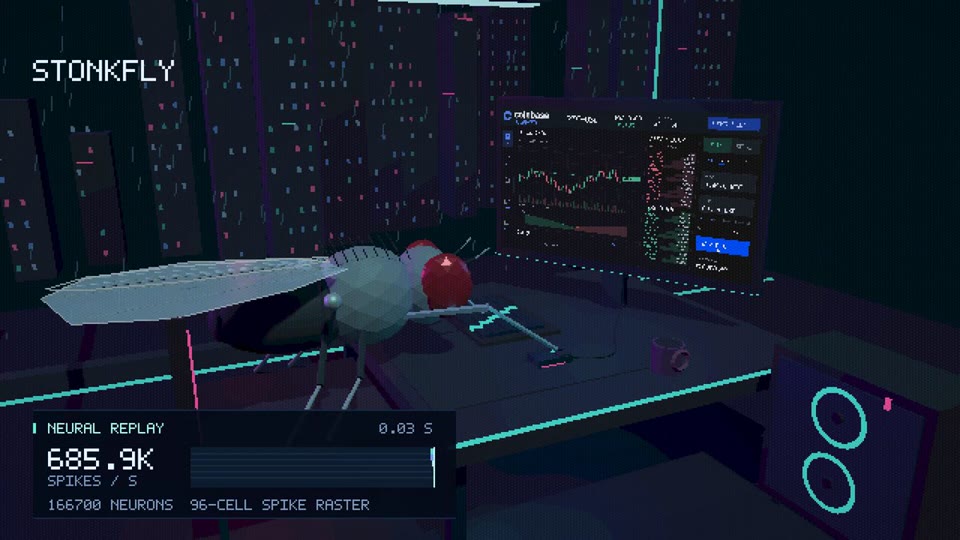
A $100 portfolio. One very small trader. Bitcoin charts become neural inputs; a fixed readout proposes buy, sell, or hold.
AWAlex Wormuth
A collection of things people are making with fruit fly brains. The games, the experiments, and the beautifully absurd.
Wait, why is everyone building with flies?Saved on this browser ·
A $100 portfolio. One very small trader. Bitcoin charts become neural inputs; a fixed readout proposes buy, sell, or hold.
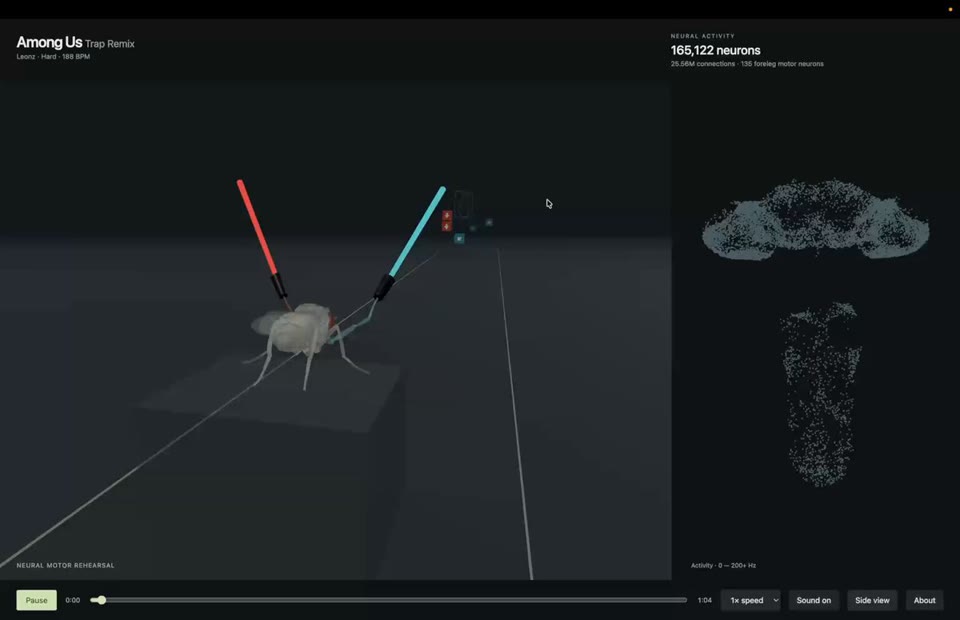
Two lightsabers, a tiny fly, and the rhythm-game clip that took over everyone’s feed.
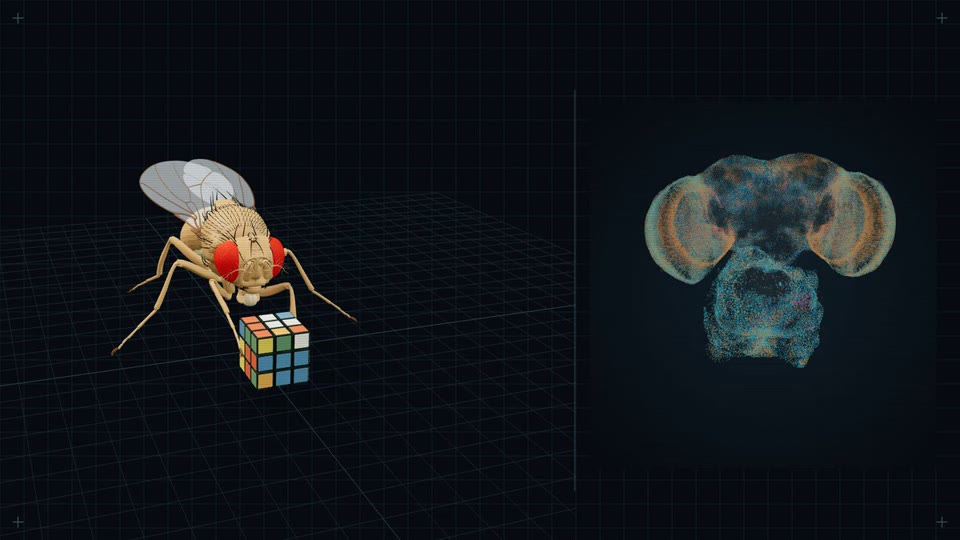
The little puzzle-solving fly from the viral eight-second video.
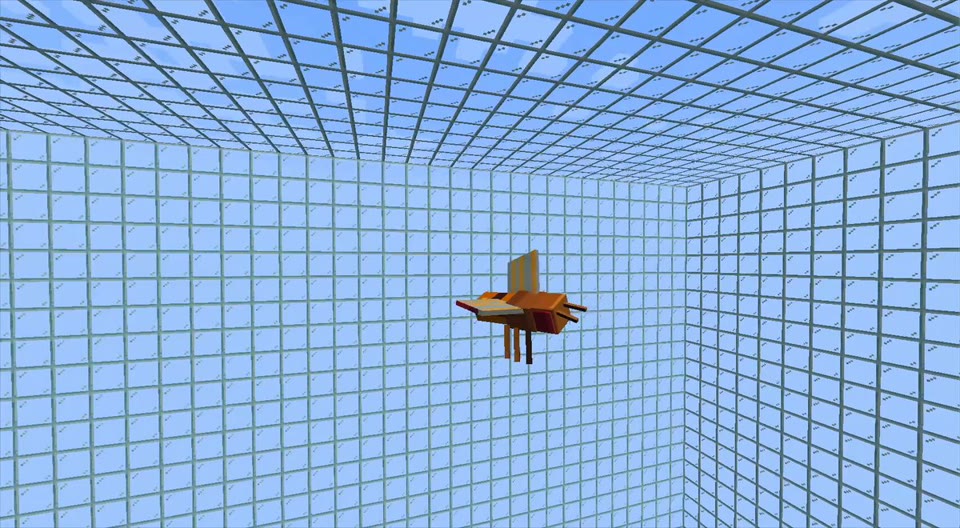
A fly moves into Minecraft, where food, light, brushing, and nearby creatures feed its simulated nervous system.
The internet’s favorite question, answered with a fly: can it run Doom? Game frames enter the modeled eyes; spikes become controls.
A tiny, articulated companion that walks, grooms, sleeps, and flees your cursor on the macOS desktop.
Give the fly a PDF. This experiment turns individual printed characters into neural activity and reads them back out as text.
Six legs on a steering wheel. A connectome-based controller steers a virtual Mini Cooper in CARLA.
Mario gets a very unusual controller: a MaleCNS model receiving views from inside Super Mario 64.
Talk to the fly. A frozen language model gets a small, trained adapter that reads activity from the fly’s connectivity graph.
Rearrange a little house, release a swarm, and help as many flies as possible find their way outside.
The fly graduates from gaming to typing Python in a miniature programming setup.
A quiet terrarium, one fly, and an uninterrupted supply of sweetness. A browser artwork about artificial embodiment.
A fly-powered instrument for Ableton Live, from dark drones to a rotating chamber of musical flies.
Born to fly. Handed a phone. An observation chamber for a fly watching an endless feed of insect videos.
An intervention in courtship-related circuitry, visualized with a small fly and recorded neural activity.
Catch it if you can. A browser arcade game that lets you peek into the circuit behind a fly’s escape response.
An independently released Minecraft mod with fly mobs, a brain view, and live motor-channel readouts.
A chessboard beside a simulated fly brain. Inspect the spike traces and try disconnecting the network.
The Chrome dinosaur gets an 80-neuron controller. Watch the circuit react as the obstacles approach.
A second act for the Rubik’s Cube fly: a creator-posted Super Smash Bros. demonstration.
The fly takes a turn at Mario Kart in a follow-up to the Rubik’s Cube video.
Six simulated flies—three male and three female—get the opportunity to interact in a tiny social network.
A tongue-in-cheek social-platform demo for a fly, complete with twenty simulated subscribers.
A video feed whose next scroll is influenced by a modeled fly circuit’s changing response to what it sees.
A fly, an iPhone Duo, and the scroll that never ends. One of the trend’s miniature workplace comedies.
A MaleCNS-based controller connected to Indian NIFTY options through OpenAlgo.
A Bitcoin-mining-themed fly demo from FutureBit joins the wave of improbable insect jobs.
A fly-font experiment that turns learned outputs into haiku and traces Japanese kana and English letters.
A six-shirt art experiment whose print placement, scale, and rotation are influenced by fly spike vectors.
A small MaleCNS circuit tracks a Pong ball, with a research log documenting what did and didn’t work.
A testbed asking whether the fly’s connection pattern helps a recurrent controller learn simple Doom tasks.
A fly-controlled game boss, an arena, a modeled retina, and live neural readouts.
MaleCNS meets FightingICE in a testbed with an explicit chain from sensory input to fighting-game actions.
A connectome-based experiment in Craftax, an open-ended survival environment.
A first-person horror prototype: find the key while a fly-linked system influences the room’s events.
A room, fruit, wind, and a fly with modeled vision, smell, taste, and movement.
An inspectable loop from a rendered world through compound eyes and modeled neurons, then back to a flying body.
A miniature laboratory for exploring neural stimuli, movement, and the provenance of a circuit.
A fly wandering along your Linux windows, with a brain window you can stimulate.
The desktop fly travels to GNOME, with sugar drops, cursor avoidance, and a live circuit display.
A persistent 3D fly and a local spiking simulation, with sensory controls and recordings of each run.
An arcade-style control panel for stimulating named neuron populations and watching modeled activity spread.
Describe a stimulus in natural language, then inspect how a FlyWire-based model responds.
A terminal-rendered connectome reservoir with recording, replay, and a Muse EEG input path.
A brain-and-body simulation with split-screen views of navigation, neural activity, and a physical fly.
A browser-based fly nervous-system experiment with brain, nerve-cord, and body simulation.
An interactive FlyWire simulation with modeled sensory stimuli and an inspectable escape pathway.
Use MaleCNS connectivity as a configurable layer inside a Python machine-learning model.
An experimental spiking simulator and 3D activity report designed for Apple Silicon GPUs.
A GPU simulator optimized for propagation through a sparse fruit-fly connectivity graph.
A debugging dashboard for inspecting and controlling neural-circuit simulations.
A larval-connectome experiment with a MuJoCo body and a multilingual stimulus interface.
Turn measured FlyWire connectivity and a compound-eye model into a trainable vision system.
A whole-brain spiking model with multiple computational backends and neuron activation/silencing experiments.
The anatomically detailed MuJoCo body behind many of the little digital flies on your feed.
A platform for simulating embodied sensorimotor control with a detailed fly body and physics.
The central resource behind the September wave: an adult male fly’s brain and ventral nerve cord, mapped at synapse resolution.
Look up neuron types, connectivity, anatomical distributions, and morphology in the male nervous system.
Paint the neurons, release to stimulate, and watch an articulated fly respond—all in your browser.
Explore how a modeled compound eye and an optic-lobe network can turn a rendered scene into flight-related signals.
The fly joins the developer tools crowd in Supabase’s miniature database-deployment video.
A MaleCNS-derived controller mapped to browser actions for a token launchpad, with a separate web-roaming mode.
The adult female brain connectome and the explorer used to inspect its neurons, annotations, and connections.
The 2024 computational study behind many of the scene’s simplified whole-brain spiking simulations.
Try another search or explore the whole collection.
 Preview from Alex Wormuth’s project post
A $100 portfolio. One very small trader. Bitcoin charts become neural inputs; a fixed readout proposes buy, sell, or hold.
The repository defaults to paper trading and offers optional Coinbase execution. Engineered dopamine inputs and changing synapses have not demonstrated profitable learning.
 Preview from lyra bubbles’s project post
Two lightsabers, a tiny fly, and the rhythm-game clip that took over everyone’s feed.
The creator says the model is overfit to one track, with replay information among its inputs. This is a motor-control experiment, not demonstrated general Beat Saber skill.
 Preview from Nick Walton’s project post
The little puzzle-solving fly from the viral eight-second video.
A creator-posted demonstration. No reproducible code or evaluation was located in the reviewed sources; the clip alone does not verify the claimed training or puzzle-solving ability.
 Preview from Evan Smith’s project post
A fly moves into Minecraft, where food, light, brushing, and nearby creatures feed its simulated nervous system.
The public repository contains footage and project documentation. Runnable mod and companion source are still being prepared. Neural readouts select and modulate scripted body programs.
 Preview from Alex Wormuth’s project post
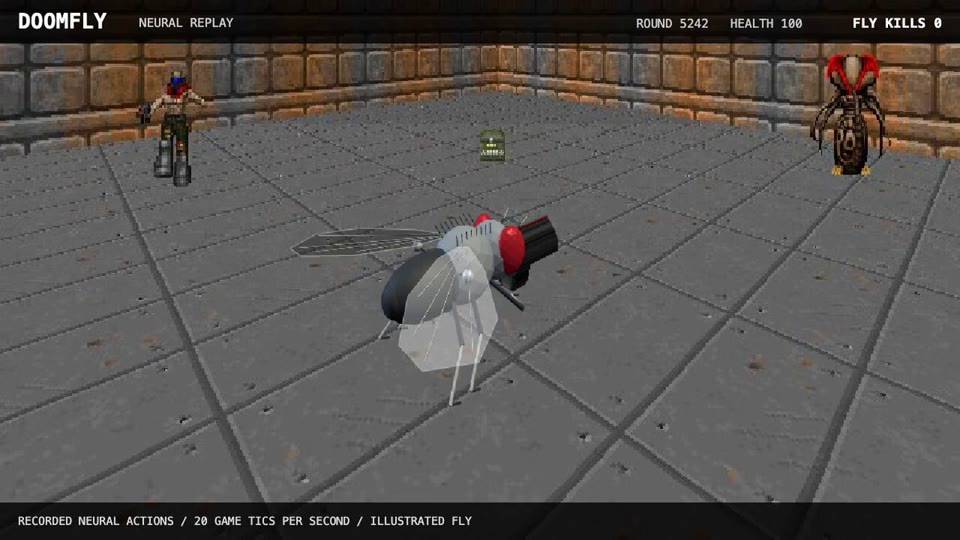
The internet’s favorite question, answered with a fly: can it run Doom? Game frames enter the modeled eyes; spikes become controls.
The full retained MaleCNS graph is connected to ViZDoom. The current v6 candidate failed visual, conditioning, and survival validation gates; learned survival has not been demonstrated.
 Preview from Denis Shiryaev’s repository
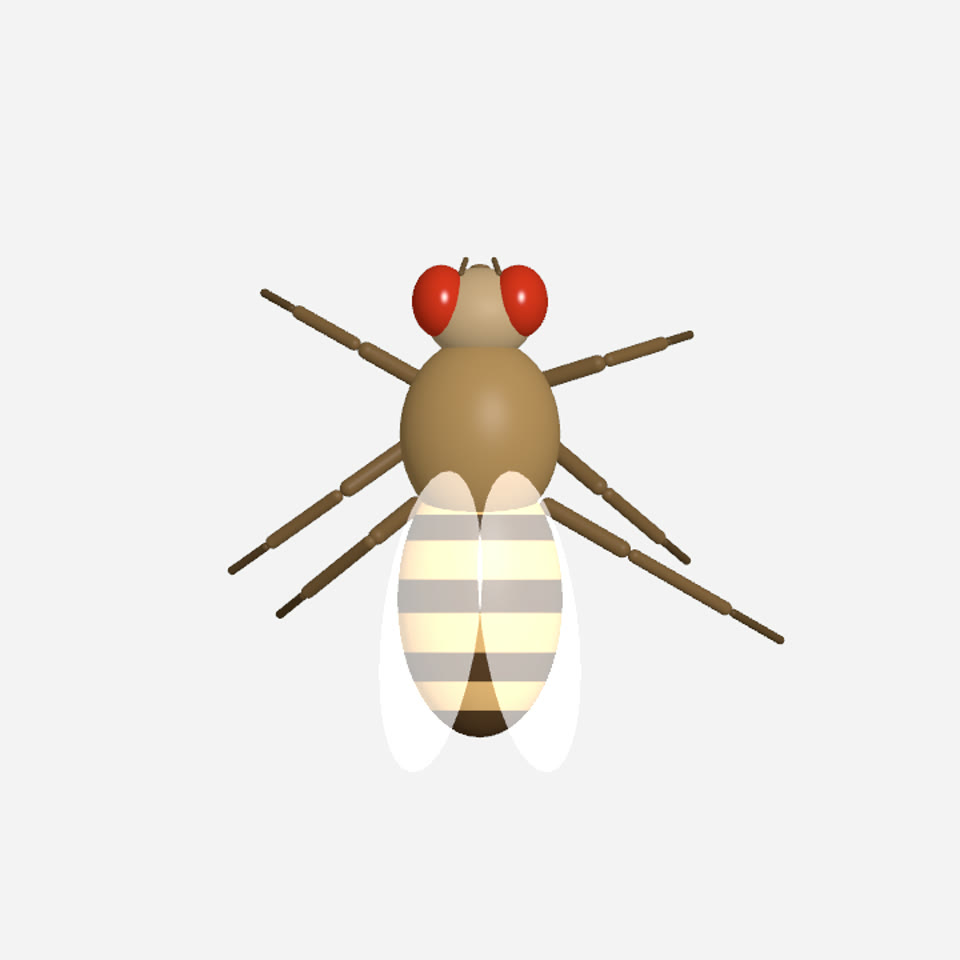
A tiny, articulated companion that walks, grooms, sleeps, and flees your cursor on the macOS desktop.
Combines selected FlyWire circuits with a 1,045-neuron MaleCNS brain-to-leg extract and modeled senses. The larger brain view displays anatomical positions; displayed points are not the simulated circuit size.
 Preview from Jerry Liu’s project post
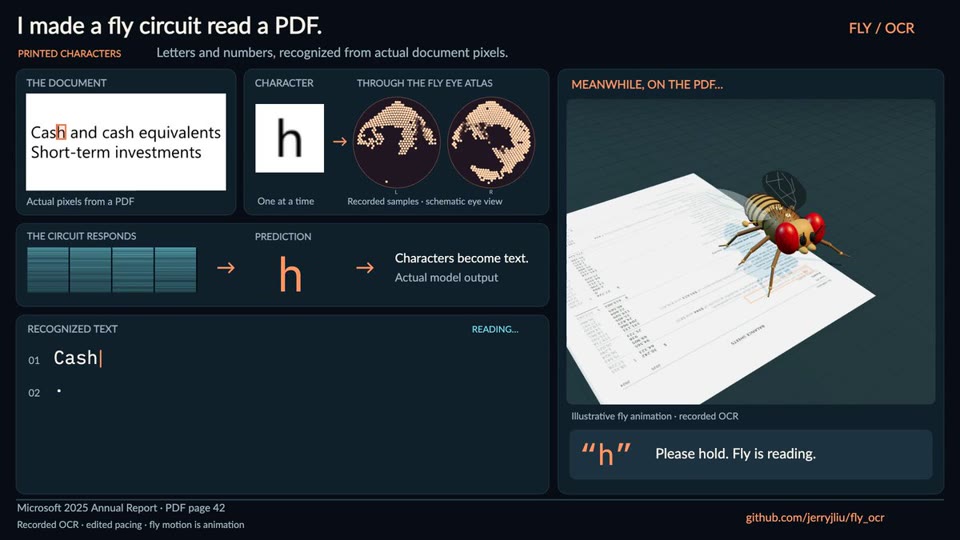
Give the fly a PDF. This experiment turns individual printed characters into neural activity and reads them back out as text.
Retains the MaleCNS graph with frozen internal weights and a trained decoder. The README reports 87.6% on a 1,632-glyph benchmark and 5.7% character error on 176 reference characters. These are limited-font, selected-crop experiments. The 3D fly is illustrative animation beside recorded OCR.
Six legs on a steering wheel. A connectome-based controller steers a virtual Mini Cooper in CARLA.
The documented result is instructed-angle steering through a simulated foreleg, including held-out targets and grip controls. Speed is scripted; autonomous visual driving remains untested.
 Preview from Jessica Paquette’s project post
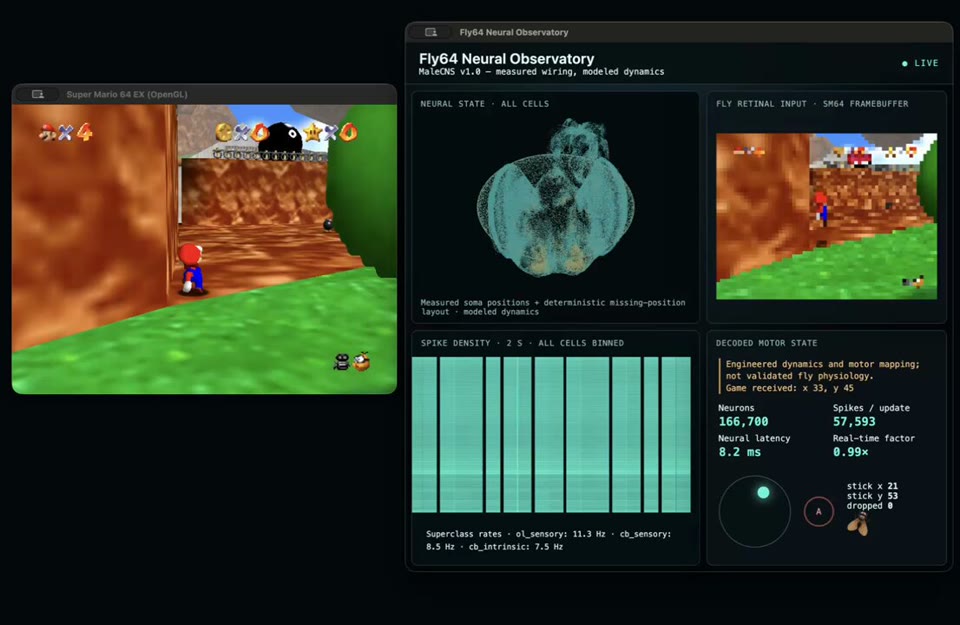
Mario gets a very unusual controller: a MaleCNS model receiving views from inside Super Mario 64.
A macOS hobby experiment with engineered sensory and button mappings. The author describes it as unreviewed, AI-assisted code tested on one Mac. Running it requires your own game ROM.
 Preview from Alex Wormuth’s project post
Talk to the fly. A frozen language model gets a small, trained adapter that reads activity from the fly’s connectivity graph.
Language comes from LFM2.5-1.2B-Instruct. Only the adapter learns; the anatomical graph stays fixed. The associated study does not establish an advantage from fly anatomy.
 Preview from David Zhang’s repository
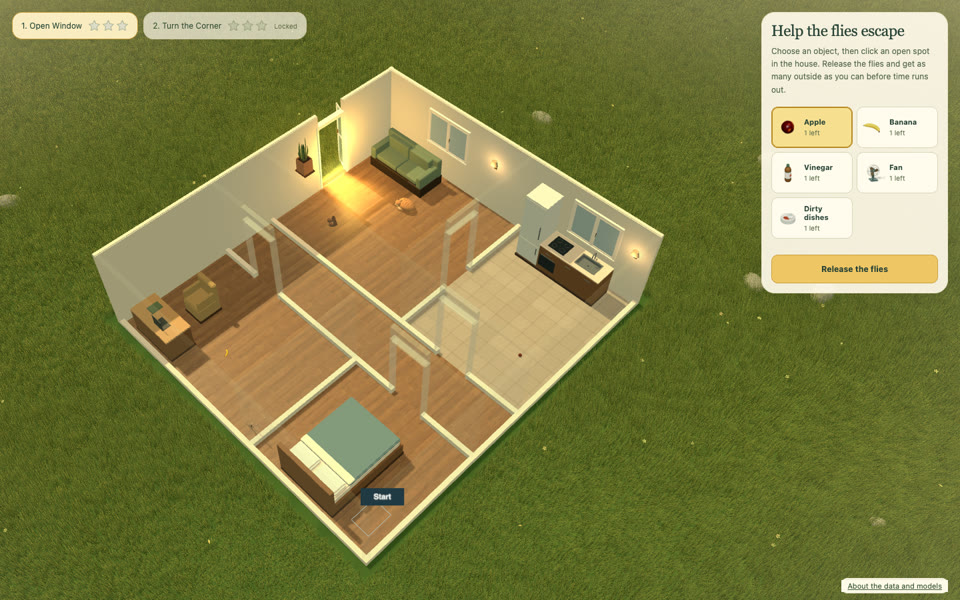
Rearrange a little house, release a swarm, and help as many flies as possible find their way outside.
A 3D browser game using a selected MaleCNS circuit, Rust/WebAssembly simulation, and authored environments. This is a circuit-based game, not a whole-animal reconstruction.
 Preview from nalin’s project post
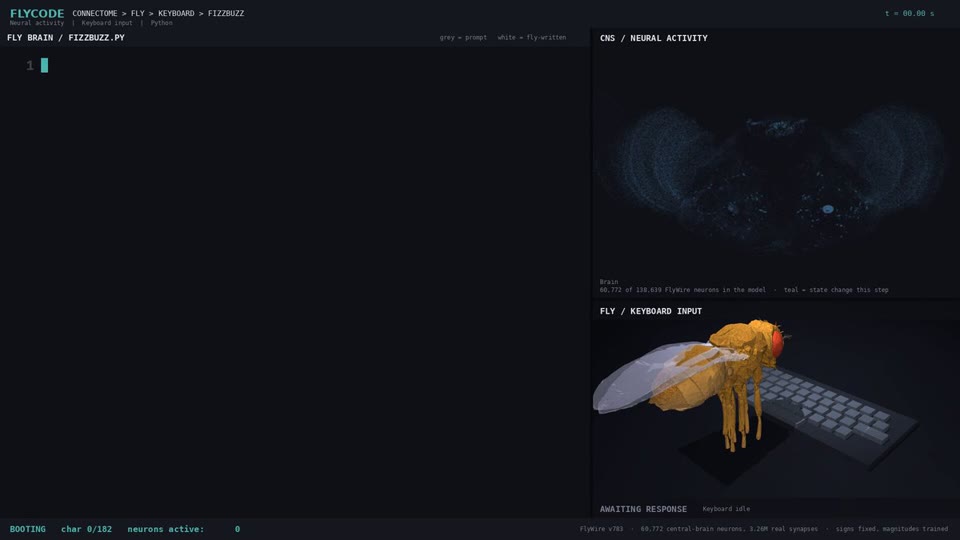
The fly graduates from gaming to typing Python in a miniature programming setup.
A viral creator video, posted with a reference to Capy. No reproducible code or evaluation was located in the reviewed thread. Programming ability is unverified.
 Screenshot of cnqso’s project website
A quiet terrarium, one fly, and an uninterrupted supply of sweetness. A browser artwork about artificial embodiment.
FlyWire-derived activity drives feeding and some body motion. Wing movements and small foot shuffles use supplied patterns. Inspired by Harris Rosenblum’s Infinite Pain.
A fly-powered instrument for Ableton Live, from dark drones to a rotating chamber of musical flies.
The Dark lab trains a small musical readout over simulated motor circuits. The harmony, rhythm, and gestures are authored; the measured wiring stays fixed.
 Preview from Matty Hempstead’s repository
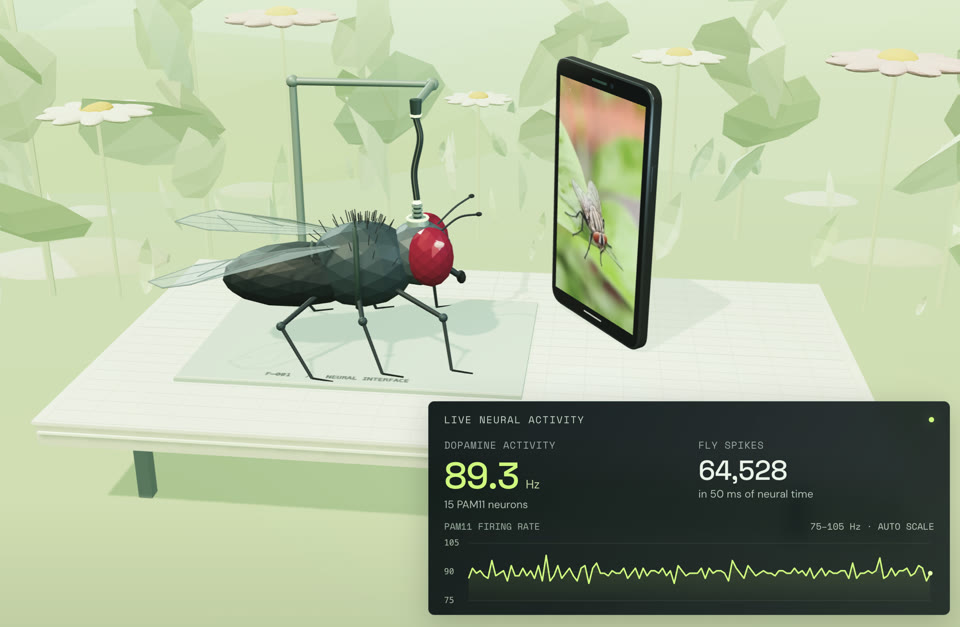
Born to fly. Handed a phone. An observation chamber for a fly watching an endless feed of insect videos.
Video frames stimulate modeled sensory inputs in a locally running MaleCNS simulation. Body motion and neural telemetry are displayed in a browser; the phone advances every three seconds.
 Preview from Nico Christie’s project post
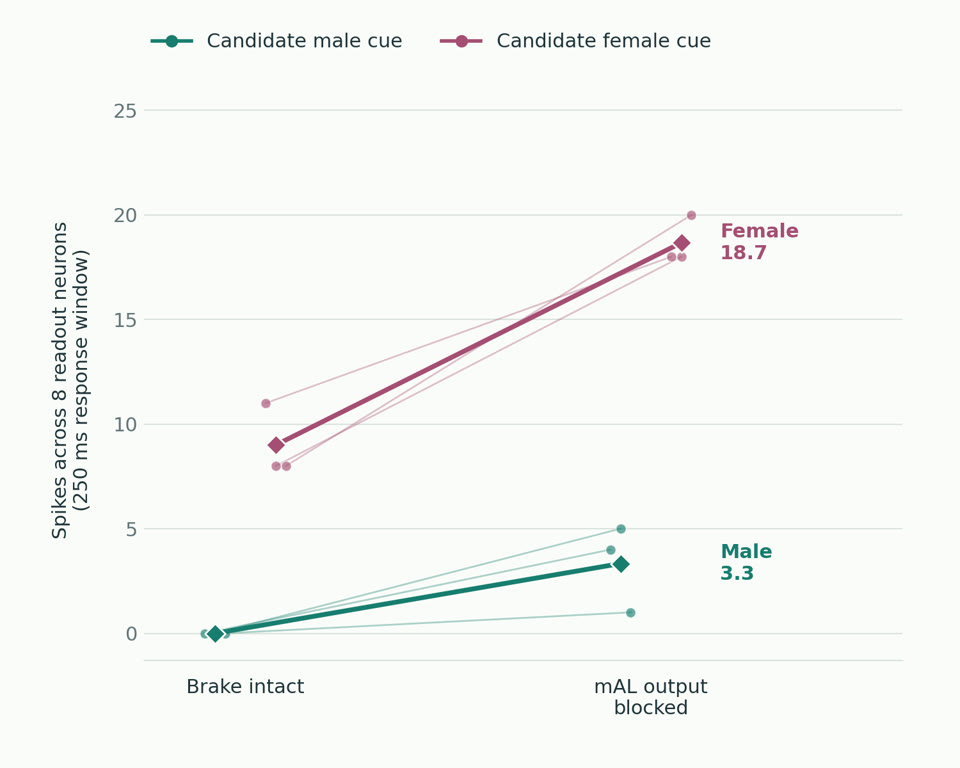
An intervention in courtship-related circuitry, visualized with a small fly and recorded neural activity.
Compares intact wiring with blocked mAL output in a 166,606-neuron model. Results are model-specific changes in candidate-neuron activity, not a demonstration of changing a real fly’s sexuality.
 Preview from hrook1’s repository
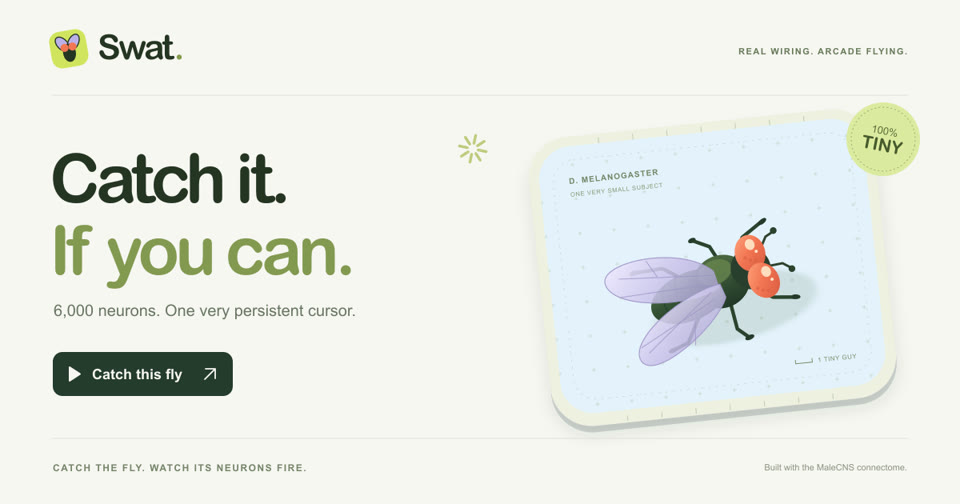
Catch it if you can. A browser arcade game that lets you peek into the circuit behind a fly’s escape response.
Uses a 6,000-neuron MaleCNS subset. Neural activity influences evasion; cruising, animation, and collisions are authored game mechanics.
 Preview from blendi-remade’s repository
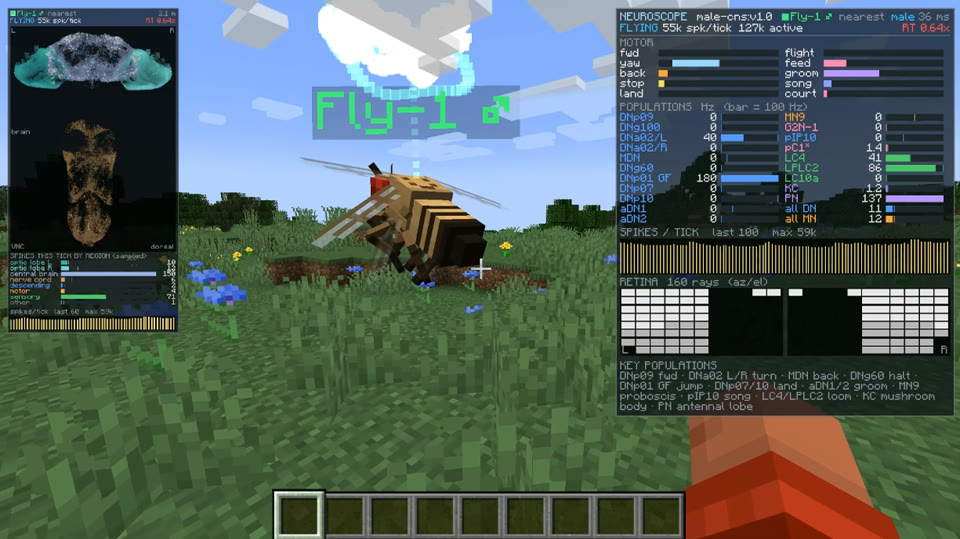
An independently released Minecraft mod with fly mobs, a brain view, and live motor-channel readouts.
A Fabric 1.21.1 mod using a filtered MaleCNS graph and project-defined sensory/motor mappings. This is separate from Evan Smith’s NeuroCraft Fly.
 Screenshot of tolatolatop’s project website
A chessboard beside a simulated fly brain. Inspect the spike traces and try disconnecting the network.
The FlyWire network runs in a browser Web Worker through Rust/WebAssembly. Chess input encoding and move scoring are engineered, and the move readout is untrained.
 Screenshot of Mert Cobanov’s project website
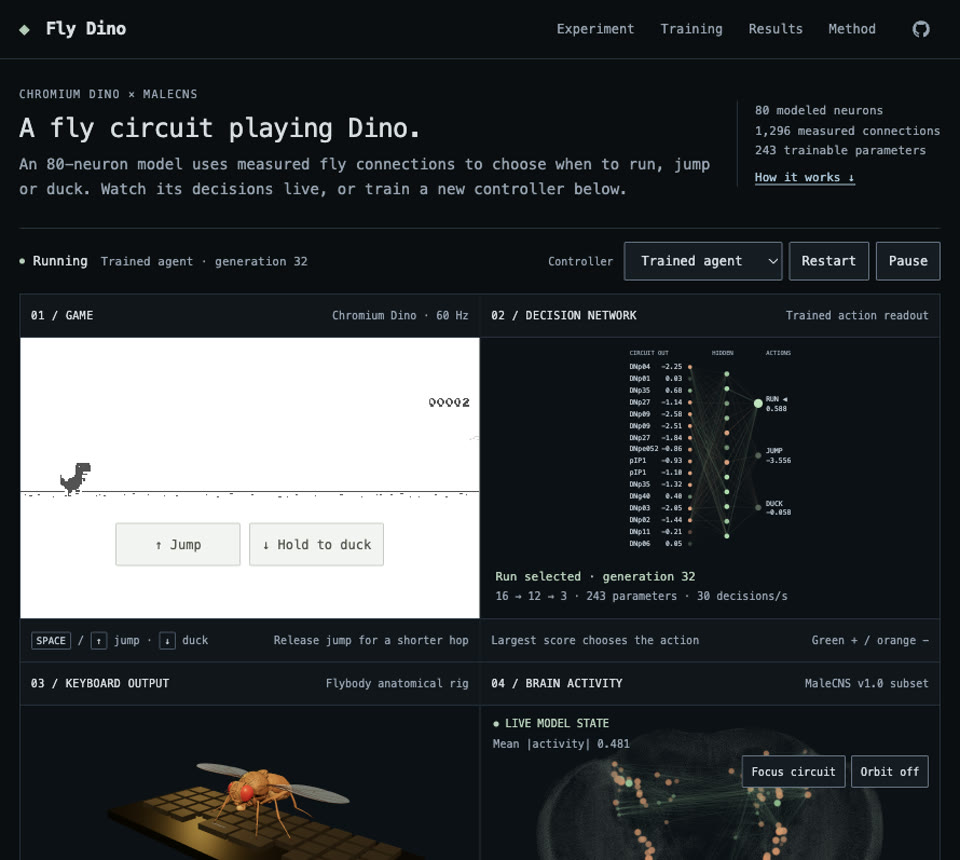
The Chrome dinosaur gets an 80-neuron controller. Watch the circuit react as the obstacles approach.
Uses a fixed MaleCNS circuit with simplified leaky tanh dynamics. Training changes a 243-parameter artificial readout; the repository includes benchmarks and silencing controls.
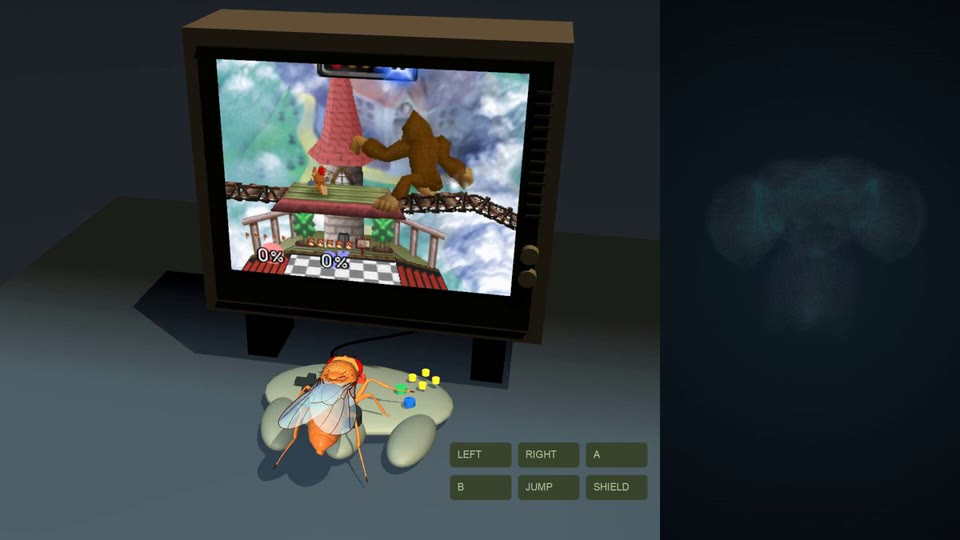 Preview from Nick Walton’s project post
A second act for the Rubik’s Cube fly: a creator-posted Super Smash Bros. demonstration.
The creator reports winning two of three matches against bots. Code, controls, and an independent evaluation were not located; treat the performance as an unverified creator claim.
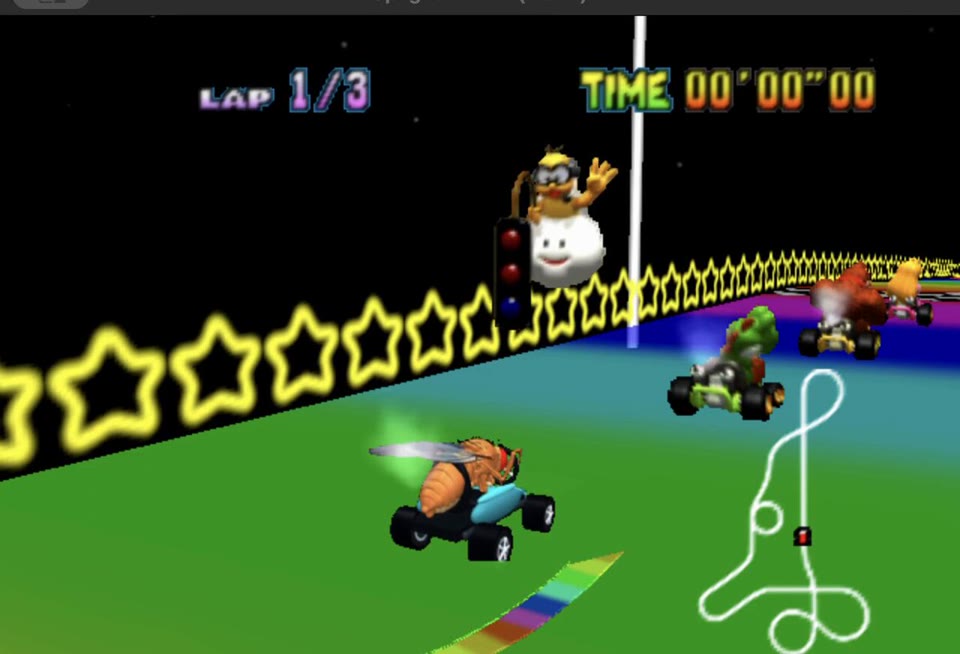 Preview from Nick Walton’s project post
The fly takes a turn at Mario Kart in a follow-up to the Rubik’s Cube video.
Creator-posted demo. No reproducible implementation or evidence of general racing ability was located in the reviewed sources.
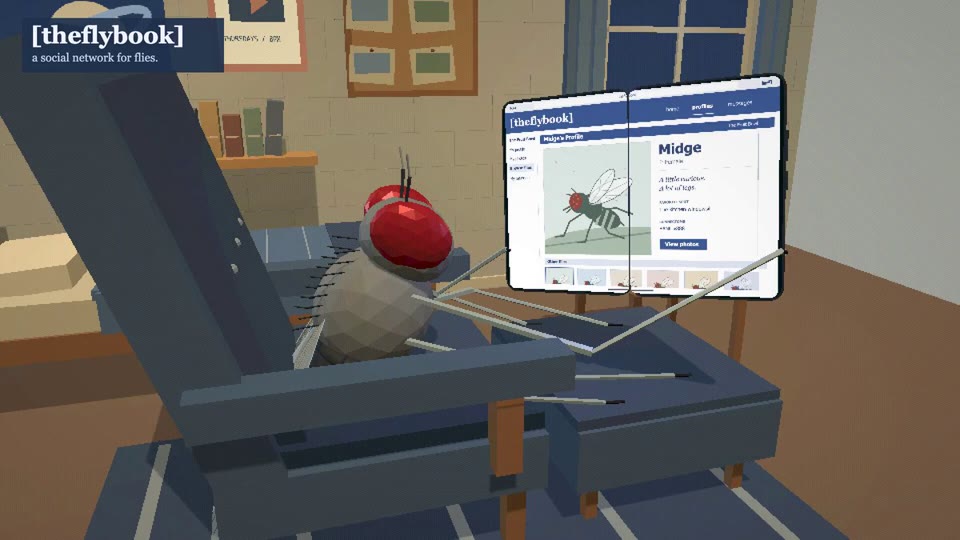 Preview from Alex Wormuth’s project post
Six simulated flies—three male and three female—get the opportunity to interact in a tiny social network.
The creator describes separate neural states and memories, with neural activity deciding responses to presentations. No public code link was located in the reviewed announcement.
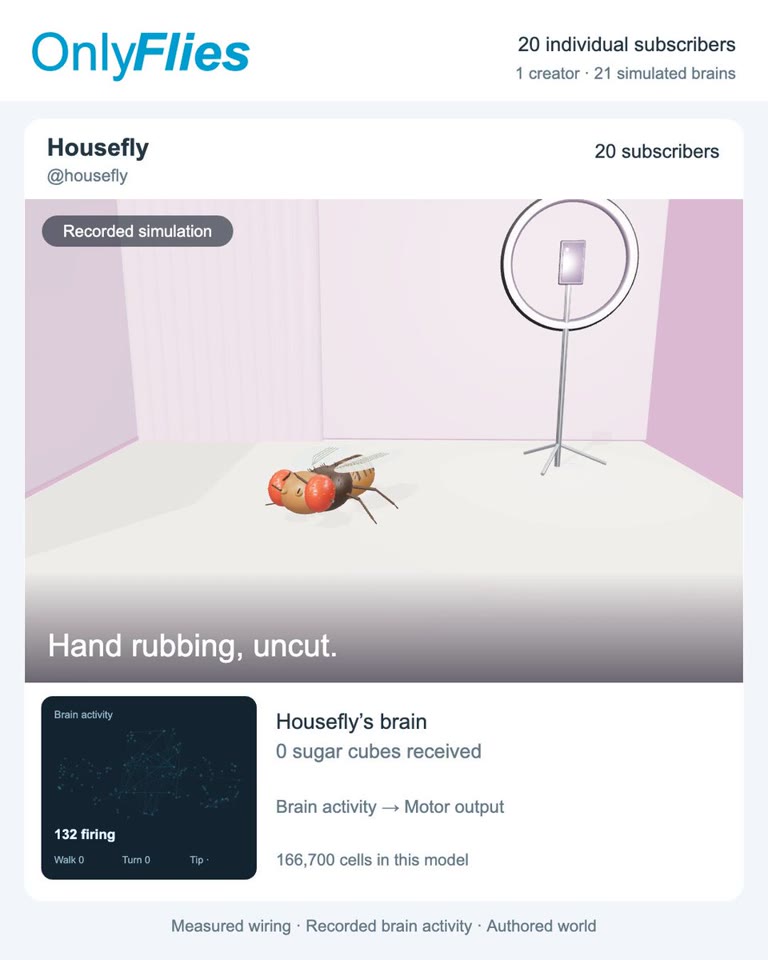 Preview from bloomy btw’s project post
A tongue-in-cheek social-platform demo for a fly, complete with twenty simulated subscribers.
A creator-posted parody. No reproducible source or evaluation was located; inclusion documents the meme, not a verified neural capability.
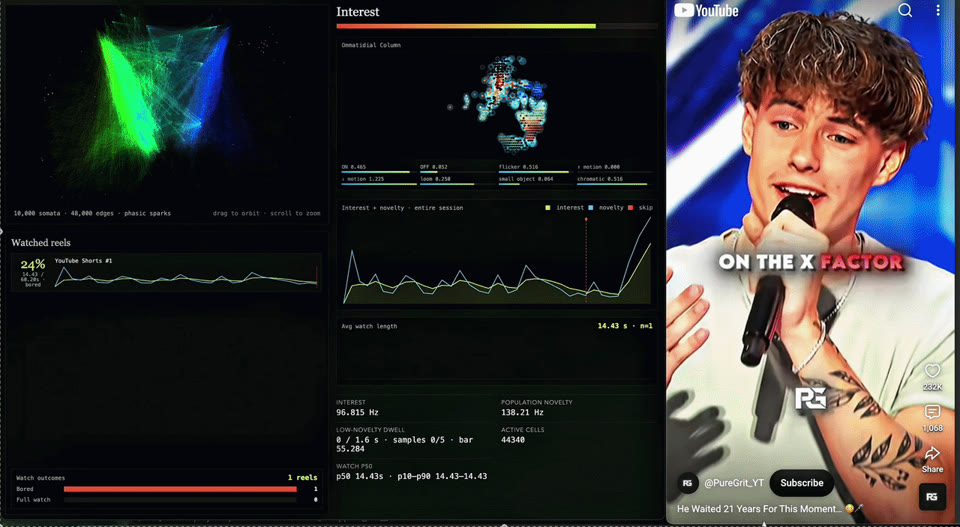 Preview from ranagwho’s repository
A video feed whose next scroll is influenced by a modeled fly circuit’s changing response to what it sees.
Uses engineered visual input, novelty calculations, and mushroom-body plasticity. Includes a visual crop and a full-graph option; a maximum-watch timeout also advances clips.
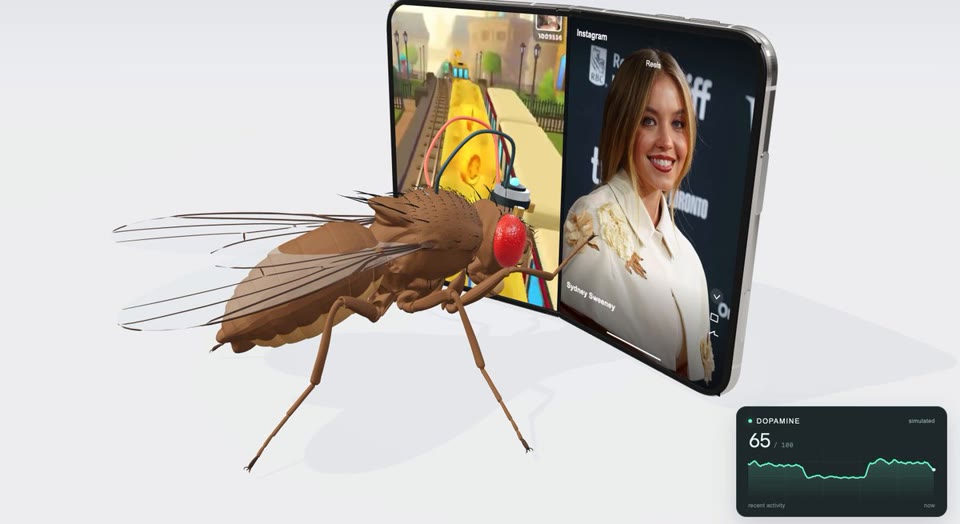 Preview from Hamudi’s project post
A fly, an iPhone Duo, and the scroll that never ends. One of the trend’s miniature workplace comedies.
Creator-posted video. A reproducible model and code were not located in the reviewed announcement.
 Preview from marketcalls’s repository
A MaleCNS-based controller connected to Indian NIFTY options through OpenAlgo.
The documented default is paper trading. Strategy rules, risk limits, and action decoding are engineered. No profitable edge has been demonstrated.
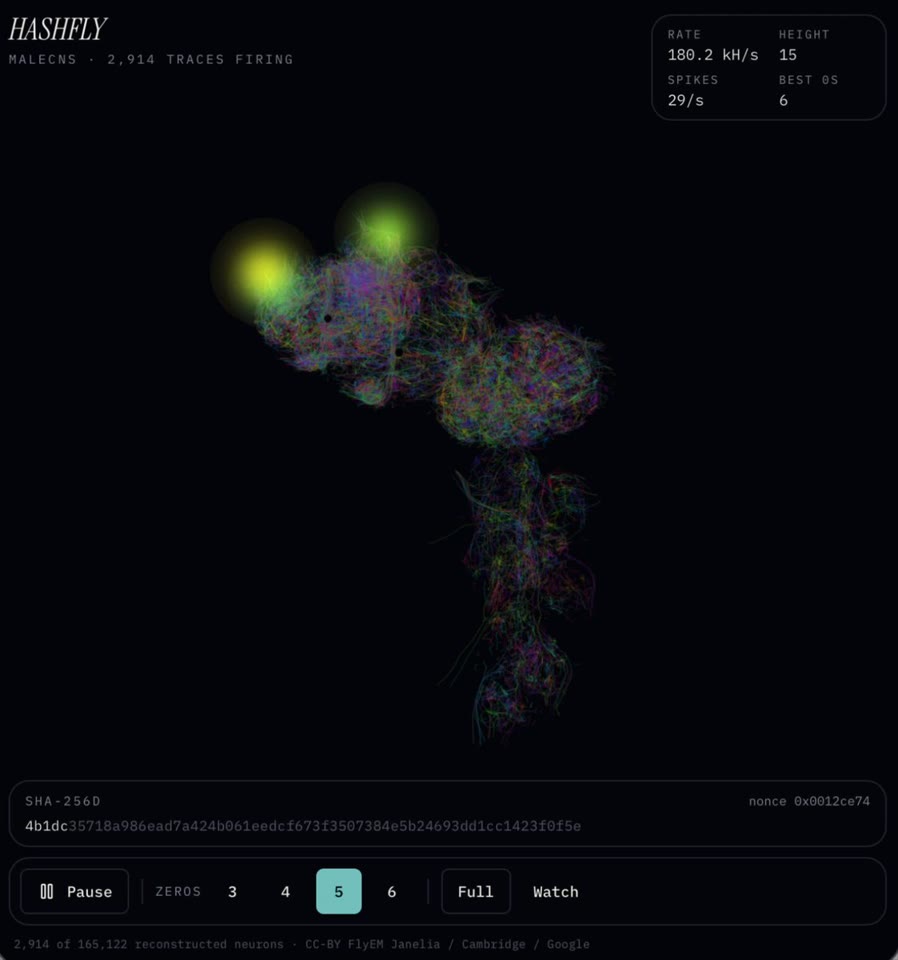 Preview from FutureBit’s project post
A Bitcoin-mining-themed fly demo from FutureBit joins the wave of improbable insect jobs.
A promotional creator demo. The claimed efficiency of hypothetical organic hardware is not a measured result for this software and is not independently verified here.
A fly-font experiment that turns learned outputs into haiku and traces Japanese kana and English letters.
Includes a full MaleCNS path and a much smaller fallback. Glyphs, rewards, and language mappings are project-defined; this does not show that biological flies compose poetry.
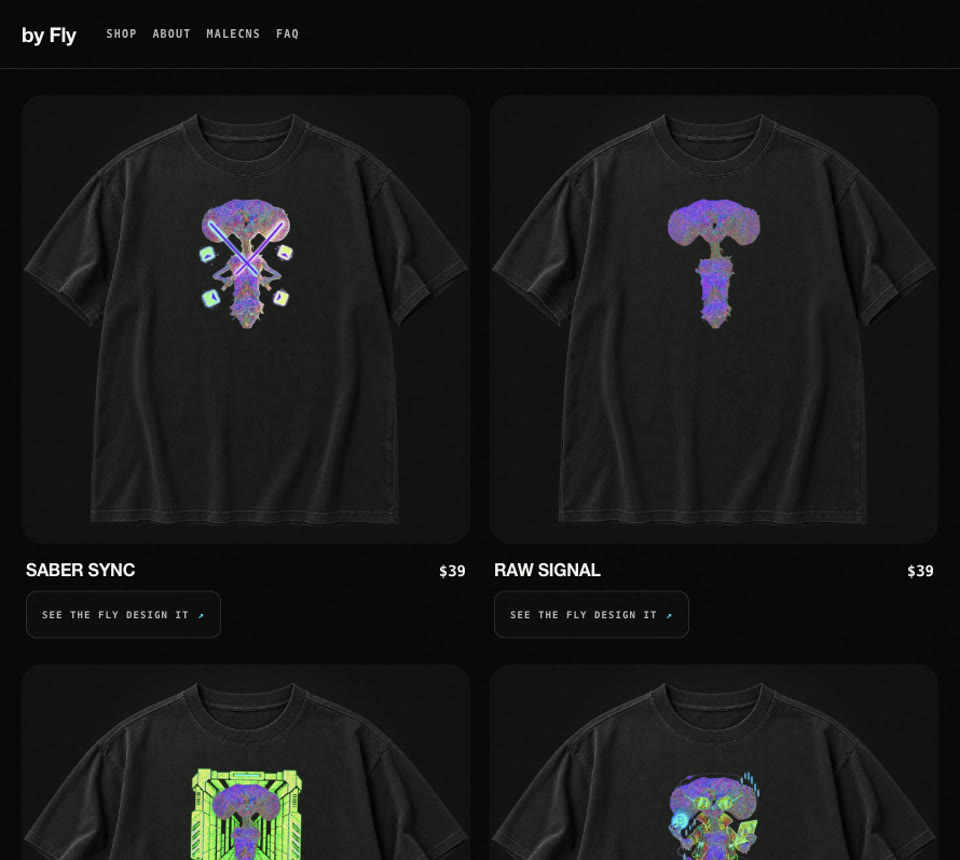 Screenshot of jtc268’s project website
A six-shirt art experiment whose print placement, scale, and rotation are influenced by fly spike vectors.
The source describes a full retained MaleCNS simulation based on Doomfly. The fly transforms existing print compositions; it does not originate every aspect of the artwork.
A small MaleCNS circuit tracks a Pong ball, with a research log documenting what did and didn’t work.
The repository reports sensory responses but no evidence of successful dopamine-based learning in its tested variants. Uses a circuit subset and a simple motor readout.
A testbed asking whether the fly’s connection pattern helps a recurrent controller learn simple Doom tasks.
Includes matched random graphs and conventional-network baselines, with several training modes. It tests an architectural constraint rather than claiming biological brain emulation.
 Preview from Jhongdlp’s repository
A fly-controlled game boss, an arena, a modeled retina, and live neural readouts.
Pairs a Rust neural engine with Python training and a Three.js viewer. Biological wiring is combined with modeled dynamics and game-specific inputs and outputs.
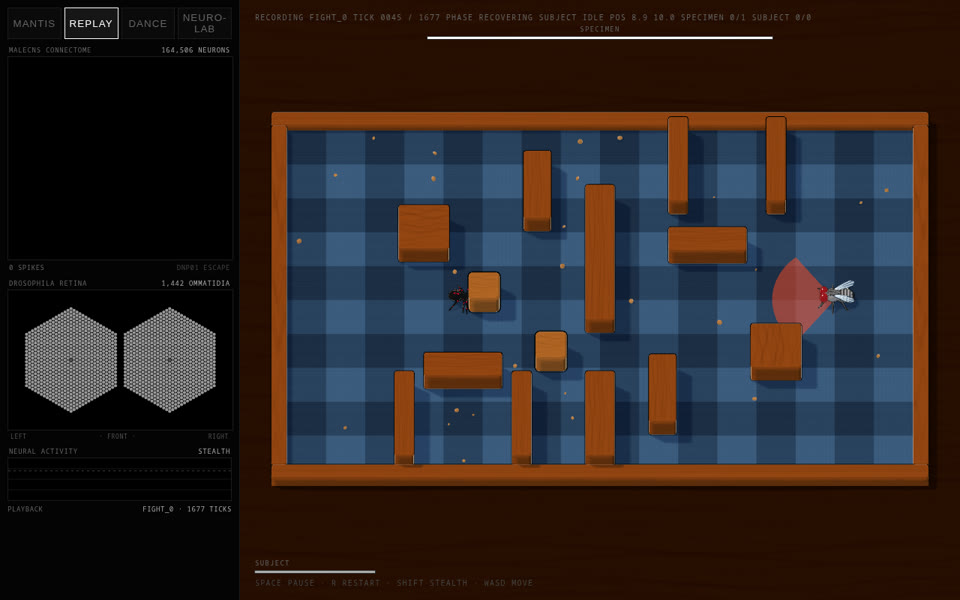
MaleCNS meets FightingICE in a testbed with an explicit chain from sensory input to fighting-game actions.
Uses modeled spiking dynamics and project-defined reinforcement and action groups. The public research ledger is distinct from the locally configured live backend.
A connectome-based experiment in Craftax, an open-ended survival environment.
Provides PPO training for a descending-neuron readout, baseline comparisons, and a replay viewer. A research prototype rather than a general survival capability claim.
 Preview from furkancak1r’s repository
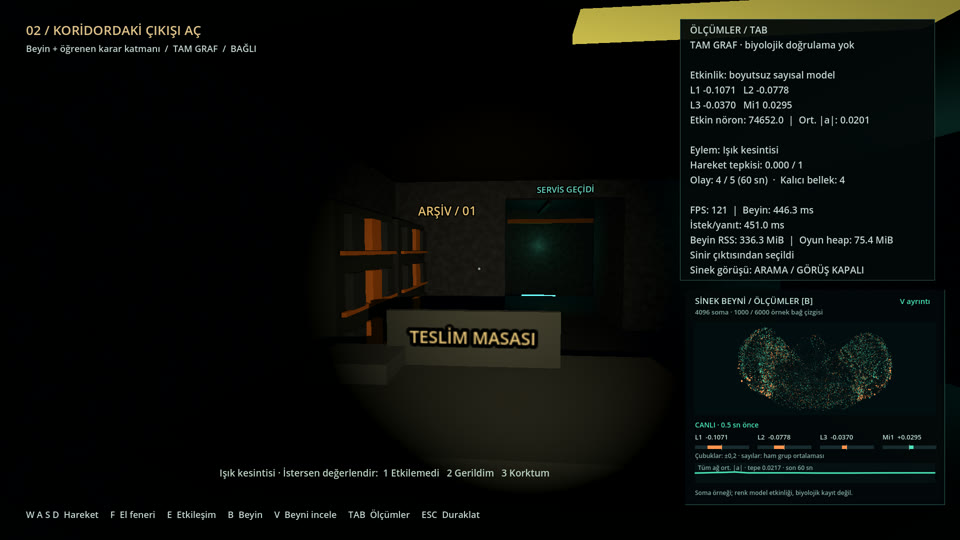
A first-person horror prototype: find the key while a fly-linked system influences the room’s events.
A Godot game using a MaleCNS-derived simulation and an external adaptive event-selection layer. The learning layer and authored horror mechanics are distinct from the measured connectome.
 Preview from tel-0s’s repository
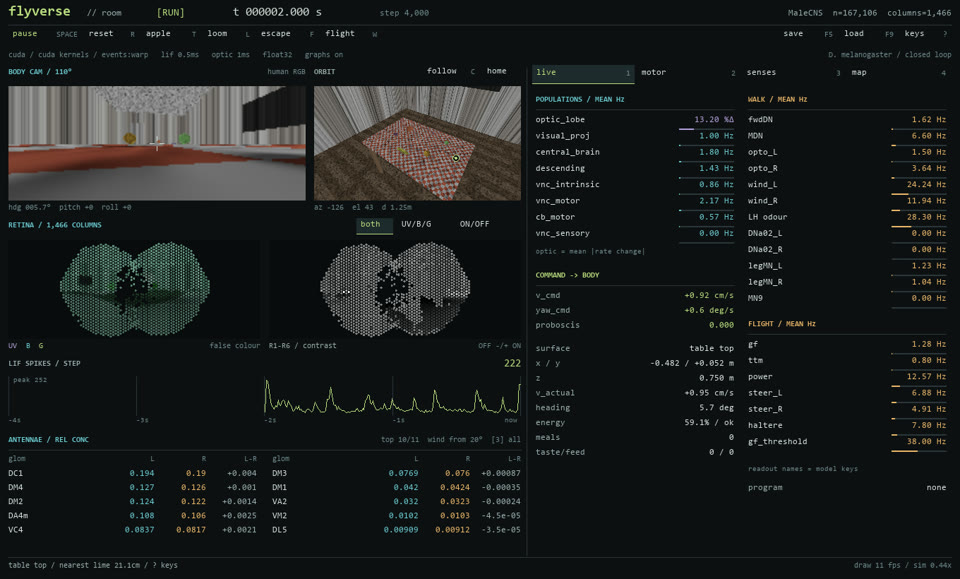
A room, fruit, wind, and a fly with modeled vision, smell, taste, and movement.
Supports MaleCNS and female datasets. Sensory physiology, brain-to-body coupling, and motor behavior depend on documented modeling assumptions.
 Preview from ZeroXClem’s repository
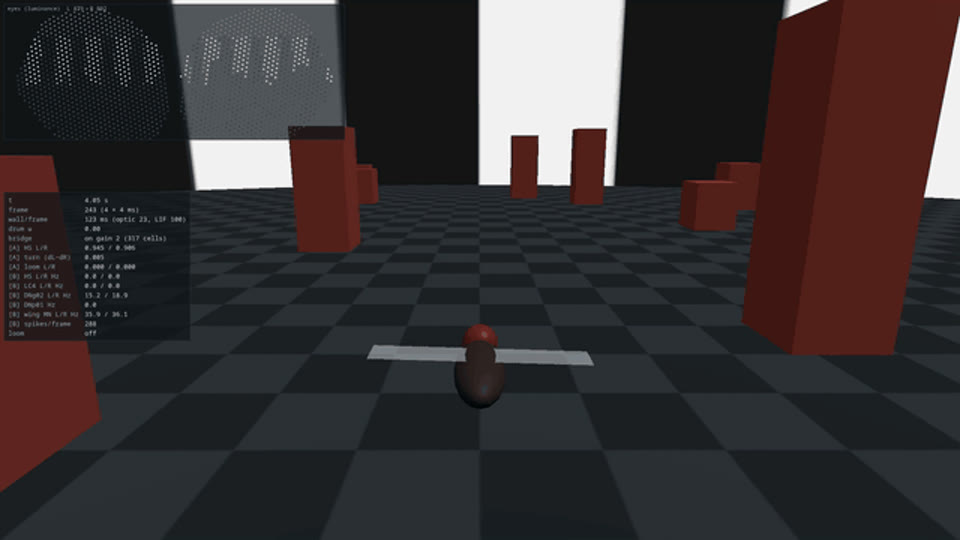
An inspectable loop from a rendered world through compound eyes and modeled neurons, then back to a flying body.
Combines AbijahKaj’s optic-lobe model with Xenova’s WebGPU simulation. The project documents the interface and distinctions between neurons, directed pairs, and synaptic contacts.
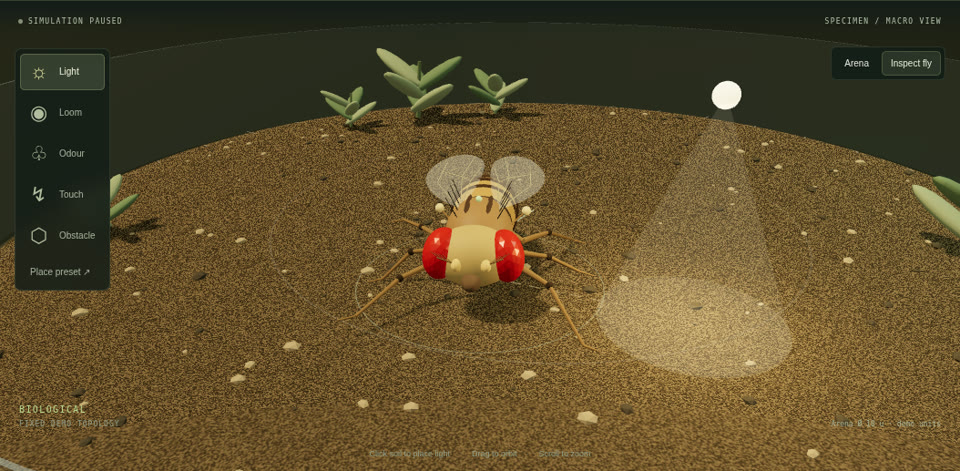 Preview from 5p00kyy’s repository
A miniature laboratory for exploring neural stimuli, movement, and the provenance of a circuit.
The default 48-neuron terrarium is synthetic. A separate 51-body MaleCNS microcircuit can be inspected and stimulated, but does not drive the fly. Its default pulse test found no topology advantage.
A fly wandering along your Linux windows, with a brain window you can stimulate.
A Hyprland/Wayland port of DesktopFly running a 668-neuron circuit. Uses modeled sensory inputs and desktop interactions.
 Preview from somsom10’s repository
The desktop fly travels to GNOME, with sugar drops, cursor avoidance, and a live circuit display.
A Python/GTK port using the upstream 668-neuron FlyWire circuit. The source documents X11/Wayland differences and platform limitations.
A persistent 3D fly and a local spiking simulation, with sensory controls and recordings of each run.
Descending-neuron activity selects measured or cached motor behavior. The authors identify sensory calibration, movement transitions, and brain-to-body mappings as approximations.
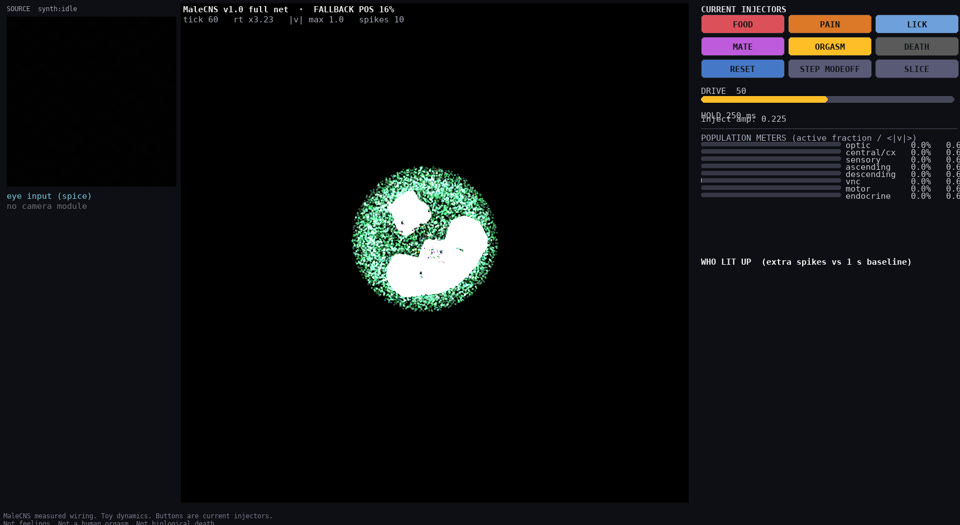 Preview from NullLabTests’s repository
An arcade-style control panel for stimulating named neuron populations and watching modeled activity spread.
Runs simplified dynamics on retained MaleCNS connectivity. Buttons inject current directly into specified populations; the display is a model-state viewer, not measured living activity.
Describe a stimulus in natural language, then inspect how a FlyWire-based model responds.
The language interface translates requests into modeled stimulation. Dopamine-learning rules and action interpretations are project-defined.
A terminal-rendered connectome reservoir with recording, replay, and a Muse EEG input path.
The README documents live Muse and synthetic-band inputs. Reservoir frequencies are properties of the digital model, not measurements of insect brain waves.
 Preview from seven-monarchs’s repository
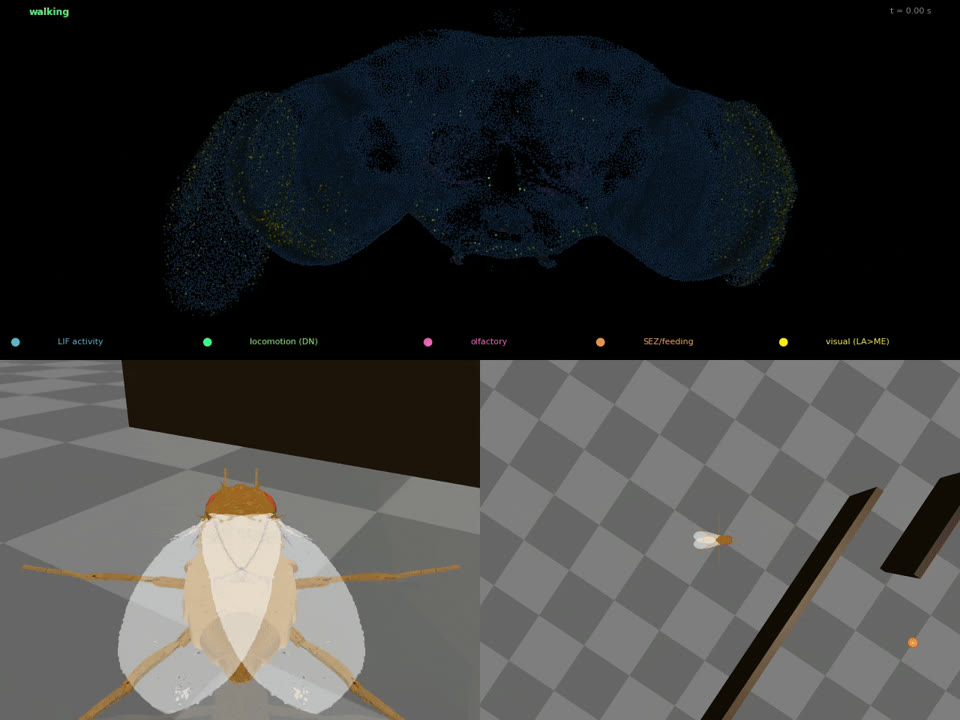
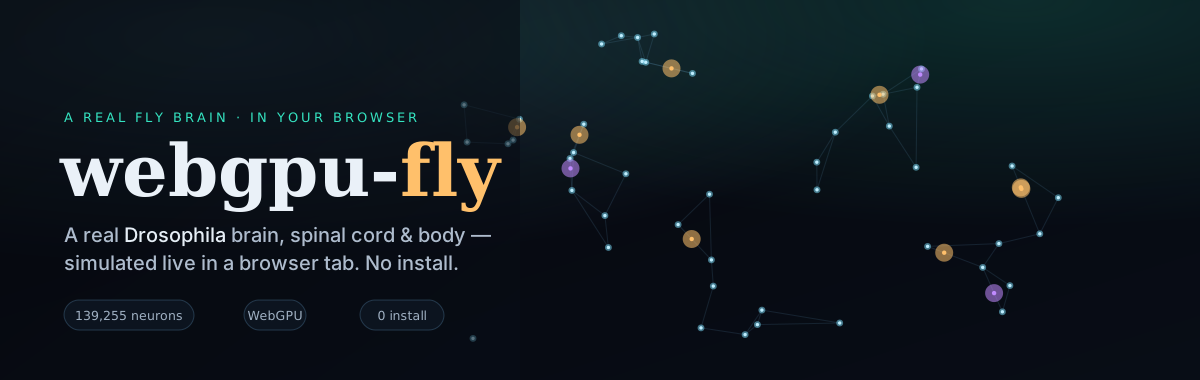
A brain-and-body simulation with split-screen views of navigation, neural activity, and a physical fly.
A personal research project built with FlyWire, Brian2, and NeuroMechFly. Its author explicitly notes that biological interpretations may be mistaken.
 Preview from abgnydn’s repository
A browser-based fly nervous-system experiment with brain, nerve-cord, and body simulation.
Combines FlyWire and MANC data through modeled interfaces. Requires WebGPU; the project inventories its approximations in a limitations document.
An interactive FlyWire simulation with modeled sensory stimuli and an inspectable escape pathway.
Uses the Shiu et al. spiking-model approach. The relationship between modeled descending activity and the digital body is an engineered interface.
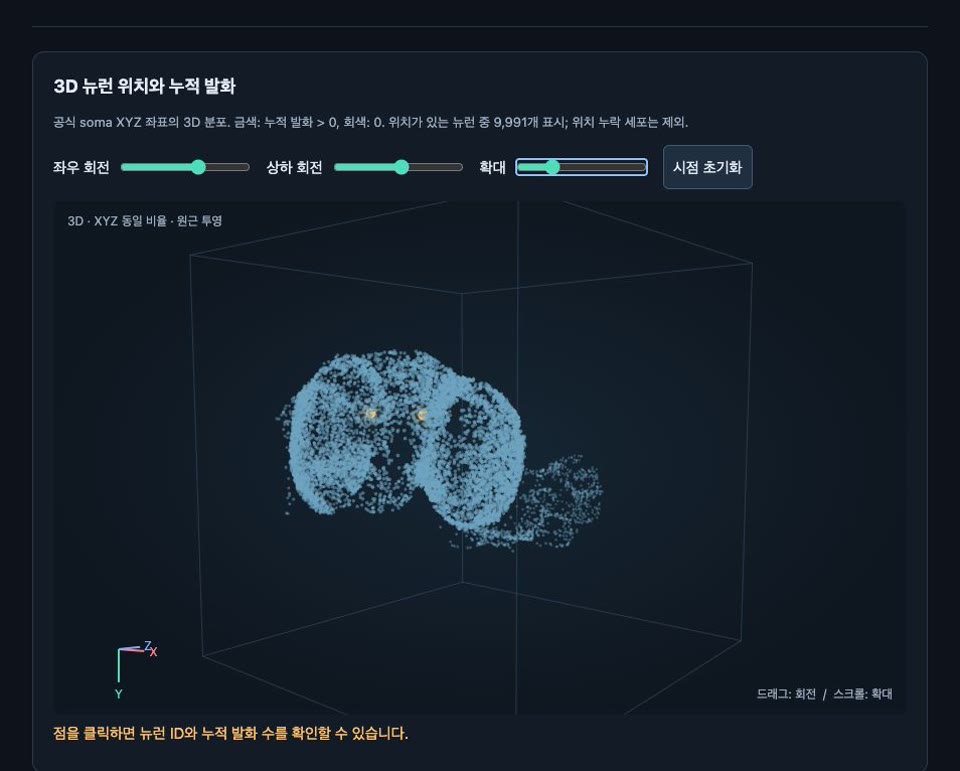
Use MaleCNS connectivity as a configurable layer inside a Python machine-learning model.
Provides NumPy/SciPy, PyTorch, and TensorFlow paths with explicit policies for signs, parameters, and backend execution. Source anatomy and computational interpretation remain separate.
 Preview from seohyunjun’s repository
An experimental spiking simulator and 3D activity report designed for Apple Silicon GPUs.
Uses official MaleCNS data with separately implemented dynamics, signs, normalization, and stimuli. It is a stimulation experiment, not a validated behavioral model.
 Preview from eonfathom’s repository
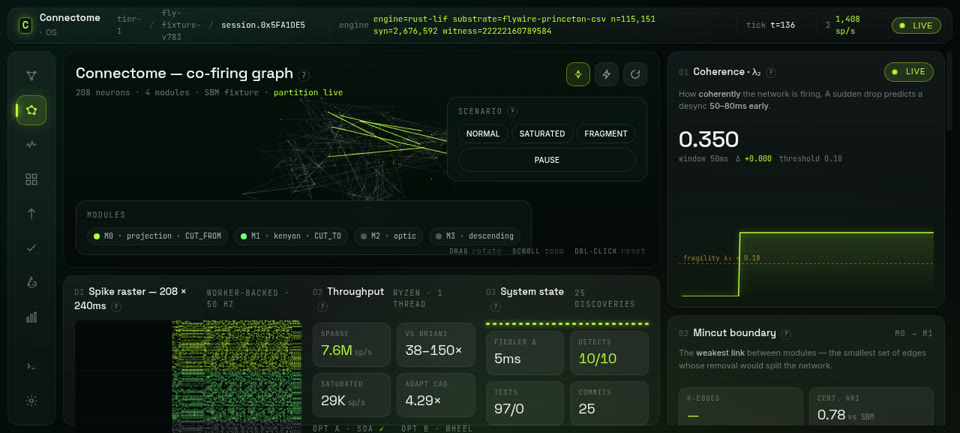
A GPU simulator optimized for propagation through a sparse fruit-fly connectivity graph.
Targets real-time or faster execution on consumer NVIDIA hardware. Throughput goals and simplified neuron dynamics do not establish biological fidelity.
 Preview from ruvnet’s repository
A debugging dashboard for inspecting and controlling neural-circuit simulations.
The public website is a static interface. Live FlyWire activity requires the Rust backend running locally; opening the hosted dashboard alone does not start a brain.
A larval-connectome experiment with a MuJoCo body and a multilingual stimulus interface.
Uses a 1,373-neuron subset of larval connectivity. Qwen parses language into sensory channels; it is a different dataset and setup from adult MaleCNS demos.
 Preview from Eudald Correig-Fraga & collaborators’s repository
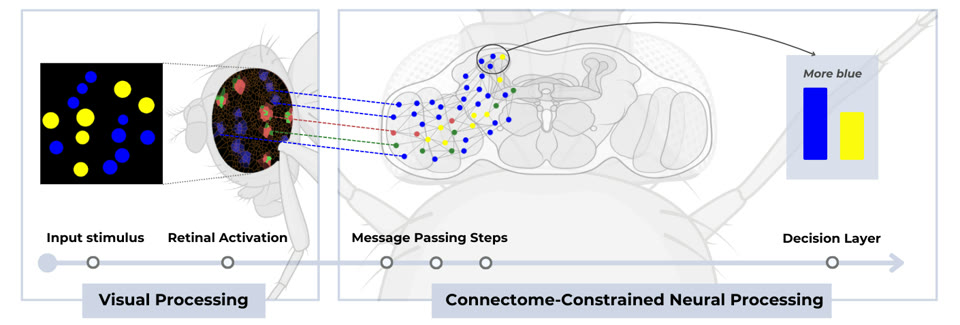
Turn measured FlyWire connectivity and a compound-eye model into a trainable vision system.
The anatomical graph remains fixed while synaptic gains, optional thresholds, and a readout can be trained. Companion experiments compare real and randomized wiring.
A whole-brain spiking model with multiple computational backends and neuron activation/silencing experiments.
Builds on the FlyWire-based Shiu et al. model. It provides a simulation framework; the connection map does not supply every biological parameter.
 Preview from Google DeepMind + HHMI Janelia’s repository
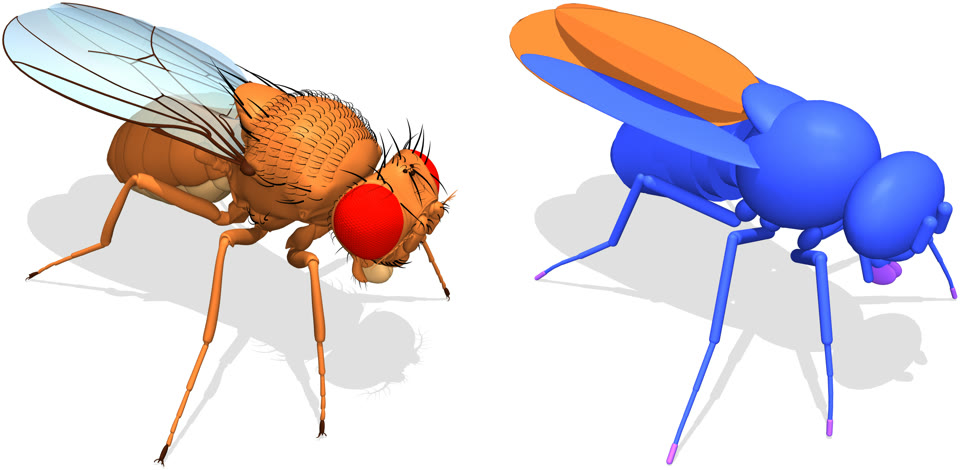
The anatomically detailed MuJoCo body behind many of the little digital flies on your feed.
A body model and reinforcement-learning platform. It provides mechanics and environments, not an automatically connected or uploaded brain.
 Preview from NeLy lab, EPFL’s repository
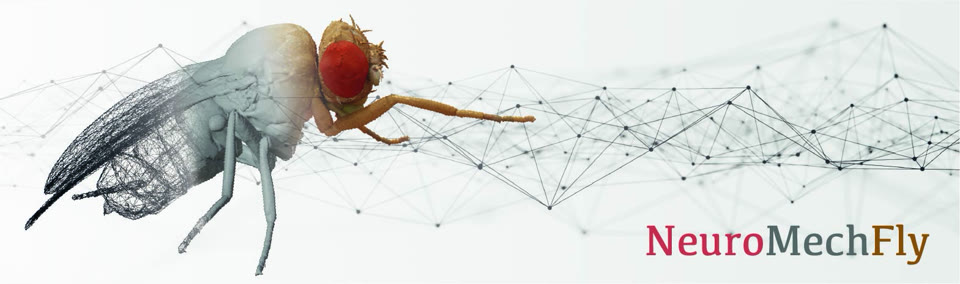
A platform for simulating embodied sensorimotor control with a detailed fly body and physics.
A scientific body/environment toolkit. It can host neural controllers, but using it alone does not imply a connectome-based controller.
 Google Research / HHMI Janelia and collaborators · original announcement
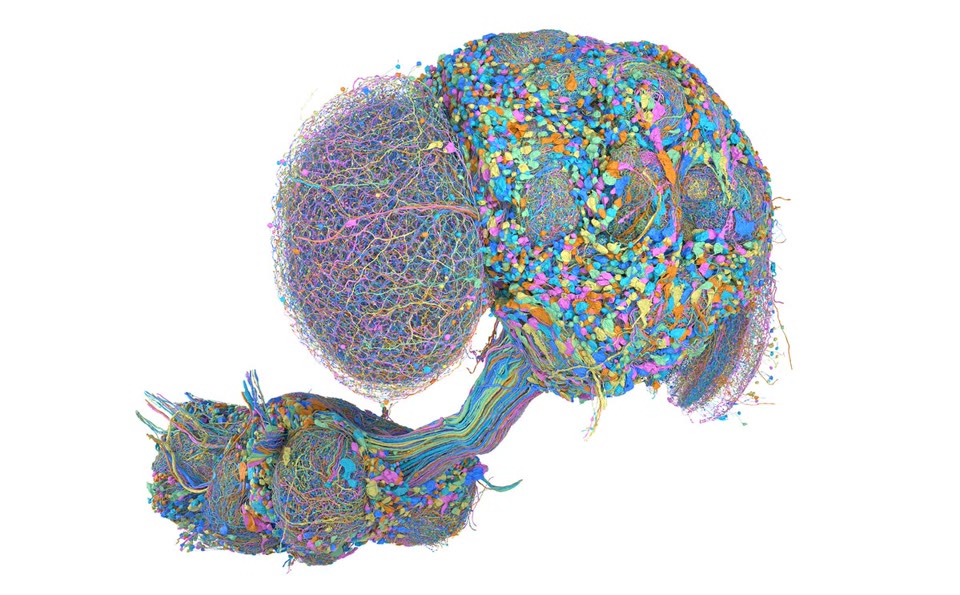
The central resource behind the September wave: an adult male fly’s brain and ventral nerve cord, mapped at synapse resolution.
The official site dates v1.0 to June 8, 2026 and the Cell paper to September 3. Counts depend on filtering: synaptic contacts and directed neuron-pair edges are different quantities.
Look up neuron types, connectivity, anatomical distributions, and morphology in the male nervous system.
An atlas and query interface for the reconstructed data, not a neural simulation.
 Preview from Xenova’s repository
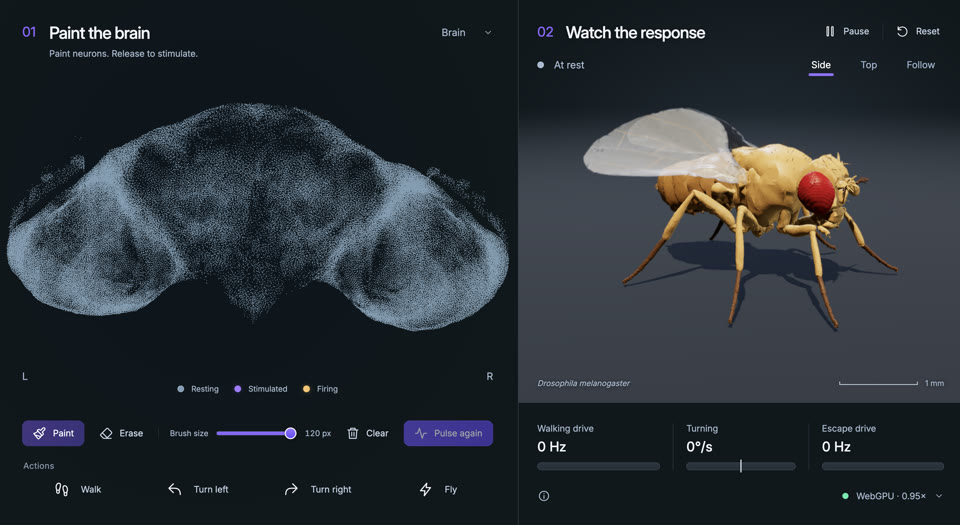
Paint the neurons, release to stimulate, and watch an articulated fly respond—all in your browser.
Uses retained MaleCNS connectivity and a simplified spiking model. Neural rates drive crafted body animations; there is no muscle, contact, or aerodynamic simulation and no body-to-brain sensory feedback.
 Preview from AbijahKaj’s repository
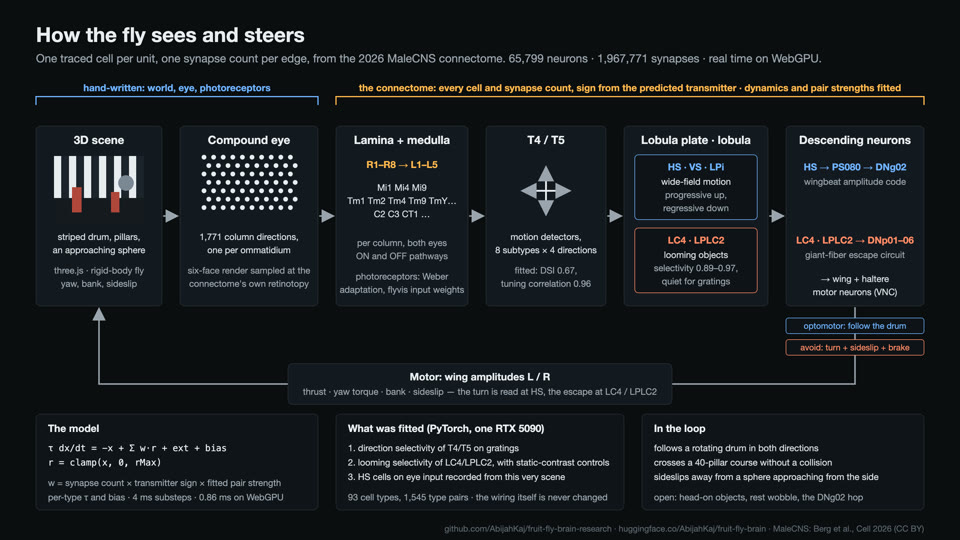
Explore how a modeled compound eye and an optic-lobe network can turn a rendered scene into flight-related signals.
A browser research workspace with a selected MaleCNS visual pathway and simplified dynamics. The body, visual inputs, and motor mappings are explicit modeling choices.
 Preview from Supabase’s project post
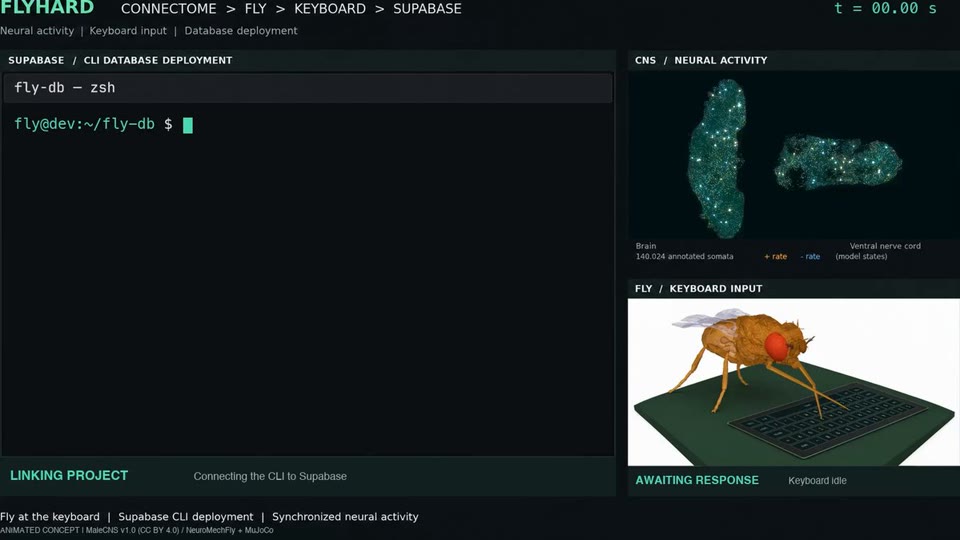
The fly joins the developer tools crowd in Supabase’s miniature database-deployment video.
A brand-posted creator demo. No reproducible implementation or independent evaluation was located in the reviewed post; it is included as part of the cultural wave.
A MaleCNS-derived controller mapped to browser actions for a token launchpad, with a separate web-roaming mode.
The repository documents engineered cursor mappings, browser automation, and transaction workflows. Inclusion records the project, not an endorsement of its tokens or an independently verified financial result.
The adult female brain connectome and the explorer used to inspect its neurons, annotations, and connections.
The 2024 flagship resource contains 139,255 proofread neurons. This is a different specimen and dataset from the adult male MaleCNS reconstruction.
The 2024 computational study behind many of the scene’s simplified whole-brain spiking simulations.
The study modeled sensorimotor circuits and experimentally tested feeding and grooming predictions. That validation does not automatically transfer to downstream game, trading, or body-control adaptations.